Today, workloads are heavier:
- AI-enabled desktop tools
- More persistent collaboration platforms
- Increased browser-based enterprise apps
- Concurrent security tooling
Devices are not just aging — they are carrying more compute demand.
.png?width=100&height=100&name=image%20(18).png "image (18)")
Over the past two years, enterprise device planning has moved from stable and predictable to volatile and uncertain.
AI infrastructure investment is absorbing memory and advanced silicon capacity at scale. Coverage from CNBC highlights sustained demand for high-bandwidth memory and GPUs driven by AI data center expansion, while IDC projects memory supply imbalance continuing into 2026. CNET similarly notes that elevated RAM and laptop pricing is unlikely to normalize in the near term.
Vendors are already responding. CRN reports vendors pulling back promotional pricing as component costs rise, and ChannelDive highlights growing emphasis on refurbishment and lifecycle extension strategies across the channel.
Tariffs on hardware imports are adding another layer of unpredictability. For organizations sourcing devices through channels exposed to U.S.–China trade policy, landed device costs may rise independent of silicon or memory market dynamics.
For IT leaders, device refresh now operates inside a different set of constraints:
▶️ Less predictable component pricingThe question is no longer “When do we refresh?”
It’s how to design lifecycle when refresh economics become unpredictable.

When pricing pressure hits, leaders react to budget first. That response is rational. But budget is only the first-order effect.
What follows are second-order effects that surface gradually:
▶️ Performance degradation
▶️ Exception accumulation
▶️ User frustration
▶️ Security ambiguity
▶️ Operational instability

Michael Meyer, Product Manager at Anunta summarized the early signals this way:
“The failure mode isn’t dramatic. It’s longer login times. Apps taking longer to load. Productivity slowly leaking out.”
These signals rarely create immediate escalation. They accumulate quietly. Users adapt. Tickets don’t always spike immediately. Which makes lifecycle decisions harder, not easier. Invisible drift is more dangerous than visible failure.
Before adjusting refresh plans, leaders need to understand where pressure accumulates structurally. That brings us to the four dimensions most affected by lifecycle stretch.
Devices are not just aging — they are carrying more compute demand.
Service desks often see noise before they see spikes
They are hidden without structured visibility.
The decision challenge becomes: Do we refresh broadly? Or isolate by workload?
That choice is now more consequential than it was in a stable pricing environment.
Lifecycle stretch intersects with OS timelines (e.g., Windows 10 end-of-life requirements) and hardware compatibility thresholds.
But more subtly, it intersects with behavior. When performance degrades beyond tolerance, users adapt.
If corporate devices underperform, behavior shifts:
This is not simply a compliance problem. It is a cultural one.
Security risk under lifecycle stretch increasingly shows up in behavior before it shows up in patch dashboards. Which forces a new question: Is your lifecycle strategy shaping behavior — or reacting to it?

15+ years in enterprise technology across cloud, infrastructure, and partner ecosystems
Former enterprise sales and cloud strategy leader at Presidio and SHI International
Leads North American GTM strategy at Anunta, aligning digital workspace architecture, partner ecosystems, and market shifts to help organizations navigate infrastructure and lifecycle change
Not every workload is equal. High-impact roles — engineering, finance, clinical, and design — feel compute constraints sooner. When refresh cycles are extended uniformly, these roles experience degradation first.
Intentional lifecycle design differentiates by:
Under pricing pressure, leaders are increasingly forced to decide:
Do we refresh by device age, or by business impact?
That’s a fundamentally different planning model.

A practical starting point is to segment devices into two groups: compute-intensive roles (engineering, finance, clinical, creative) and task-based roles (data entry, communications, light productivity work). Compute-intensive roles typically experience performance degradation 12–18 months earlier, and each affected device carries a higher productivity cost.
In constrained budget years, prioritizing these populations often recovers more value than deferring refresh across the entire fleet.

Historically, device refresh planning was relatively predictable. Organizations could estimate hardware costs, schedule replacement cycles, and align capital spend with multi-year procurement plans.
That predictability is fading.
With component pricing fluctuating and supply conditions shifting, lifecycle decisions now carry more financial uncertainty. Instead of a stable refresh cadence, many organizations are falling into one of two patterns:
Large refresh waves delayed → capital spikes later
When refresh cycles are pushed out to manage short-term cost pressure, devices accumulate. Eventually, replacement becomes unavoidable, forcing large capital events that are harder to plan and justify.
Gradual deferral → hidden productivity drag
Historically, device refresh planning was relatively predictable. Organizations could estimate hardware costs, schedule replacement cycles, and align capital spend with multi-year procurement plans.
That predictability is fading.
With component pricing fluctuating and supply conditions shifting, lifecycle decisions now carry more financial uncertainty. Instead of a stable refresh cadence, many organizations are falling into one of two patterns:
Large refresh waves delayed → capital spikes later
When refresh cycles are pushed out to manage short-term cost pressure, devices accumulate. Eventually, replacement becomes unavoidable, forcing large capital events that are harder to plan and justify.
Gradual deferral → hidden productivity drag
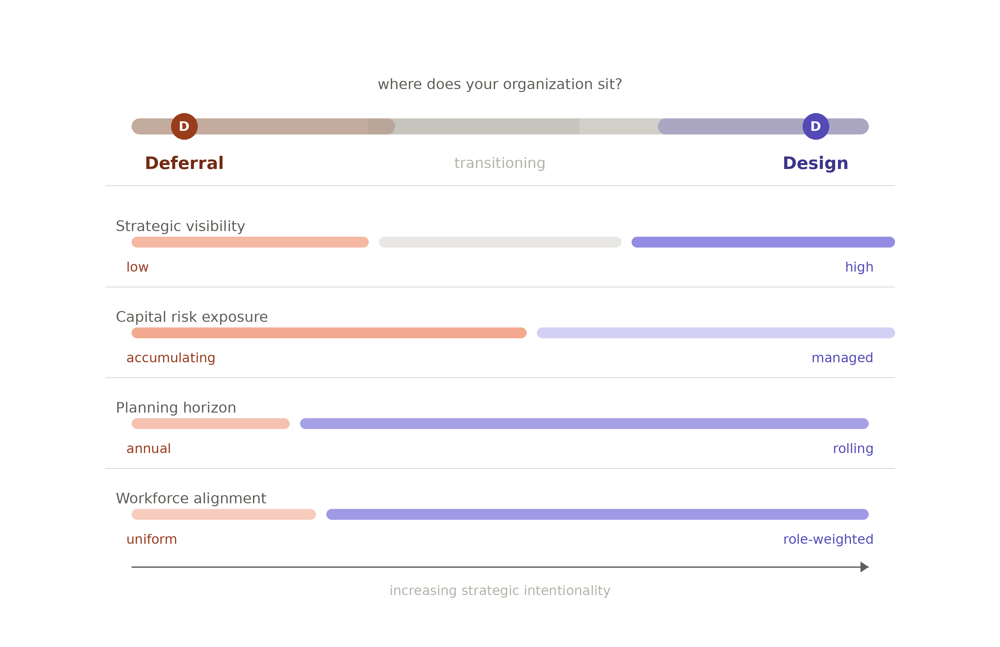
For some workload segments, the answer to lifecycle stretch isn’t a newer device — it’s a different delivery model.
Centralized compute options such as Azure Virtual Desktop, AWS WorkSpaces, Omnissa Horizon, DesktopReady, and other Desktop-as-a-Service platforms can extend the useful life of existing endpoints by shifting processing demand off the device. Compute-intensive applications can run in centralized infrastructure while users continue working from the same interface on their existing machines.
But technology alone doesn’t solve the lifecycle challenge. The real shift is in how decisions are made.
Many organizations believe they are extending lifecycle. In practice, they are deferring decisions.
The difference is subtle but important.
Deferral looks like:
Design looks like:
Under pricing volatility, this distinction becomes critical.
Deferral allows pressure to accumulate quietly — until performance degradation, exception growth, or capital spikes force reactive decisions.
Design does the opposite. It models tradeoffs early and adjusts sequencing before those pressures compound. Which is why many organizations are beginning to test lifecycle assumptions before committing to structural change. And that’s exactly what the Lifecycle Lab is designed to help you do.
Before adjusting refresh plans for the next six months, pressure-test your assumptions.
The Hardware Lifecycle Lab below allows you to model tradeoffs across four variables:
▶️ Refresh investment
It is not a score. It is a rehearsal. It reveals where pressure accumulates first — and what stabilizes volatility.
Set your approach for the next 6 months.
These are the areas most likely to feel pressure in the next 6 months.
Once you’ve explored the model, the next step is translating that clarity into operational action.
Over the past several years, AI-driven infrastructure demand has tightened component supply. Memory pricing remains volatile. Workloads are heavier. User expectations have not lowered.
In that environment, lifecycle decisions require:
Across digital workspace orchestration, monitoring and telemetry, centralized compute strategies, and lifecycle governance design, our work centers on one principle:
Make lifecycle decisions measurable before they become expensive.
If hardware pricing volatility continues — as current reporting suggests it may — lifecycle maturity will become a differentiator, not just an IT hygiene factor.
This is no longer about replacing devices every four years. It is about designing resilience into the digital workspace.
What’s changing is not just device pricing — it’s how lifecycle decisions must be made. Reactive extension is giving way to intentional design, where tradeoffs are modeled, workloads are differentiated, and visibility guides capital decisions rather than the other way around.

This structured diagnostic engagement is for organizations looking to extend device lifecycle under cost pressure
Get a PDF version of the complete analysis, including expanded architectural considerations and cited industry reporting.